We left the park at 9:00 when the temp was 17C (62.6F). Driving across Hwy 86 is an everchanging landscape. Flat, barren, no cacti, then a 'forest' of saguaros.
Heading north on Hwy 15, we encountered a Border Patrol stop. I guess they were checking for smuggled aliens!
Passed fields of cotton plants on the way to Casa Grande.
This is our site, just like the others!
Friday, March 16, 2012
Thursday, March 15, 2012
March 12, Touring Organ Pipe
At 9:15, we set off to drive the 21 mile scenic Aho Mountain loop and hike on the 4.1 mile Estes Canyou/Bull Pasture Trail.
The red line is the drive.
Lynda inspecting a large saguaro. The needles are very hard and sharp!
We came across some dead saguaro, showing the ribs that hold it up. They are wooden tubes that transport water, when it is available.
We also came across some dead Cholla Cactus, showing the skeleton structure.
Wind, not weather formed this double arch. Natural arches are rare in the park. The big arch is 36" (11M) high, 90' (27M) wide, and more than 720' (220M) long.
Next along the drive was the trailhead for the Estes Canyon,Bull Pasture trail, so we parked & set off. From "you are here", we went up on the blue trail, then around and back across the red trail, which comprised a 4.1 mile hike.
Us and a magnificent Organ Pipe Cactus and a Saguaro
We exited the trail at 1:25, had a picnic lunch then continued the loop drive. The road was "graded" but very rough. Good thing we were in the truck!
After supper, I went to the campground restroom for a shower and had the day's dust blasted from me with HIGH POWER - HOT water! Then ready for a quiet night. Lots of stars to be seen!
March 11, Moving on to Organ Pipe Cactus National Monument
*Daylight Savings starts in most places, but NOT in Arizona*
We were on the road by 10:00, with the temperature already a sunny 21C (70F). Gonna be another hot one!
Fuelled up at Gila Bend at a Texaco - $4.299 / gallon for diesel. 1:00, the temperature has risen to 27C (80.6F).
Entered Organ Pipe Cactus National Monument (remember the lesson about National Parks & National Monuments?)
Franklin D. Roosevelt created Organ Pipe Cactus N.M. on April 13, 1937.
We arrived at the Visitor Centre, watched an orientation slide show and walked an interesting nature trail.
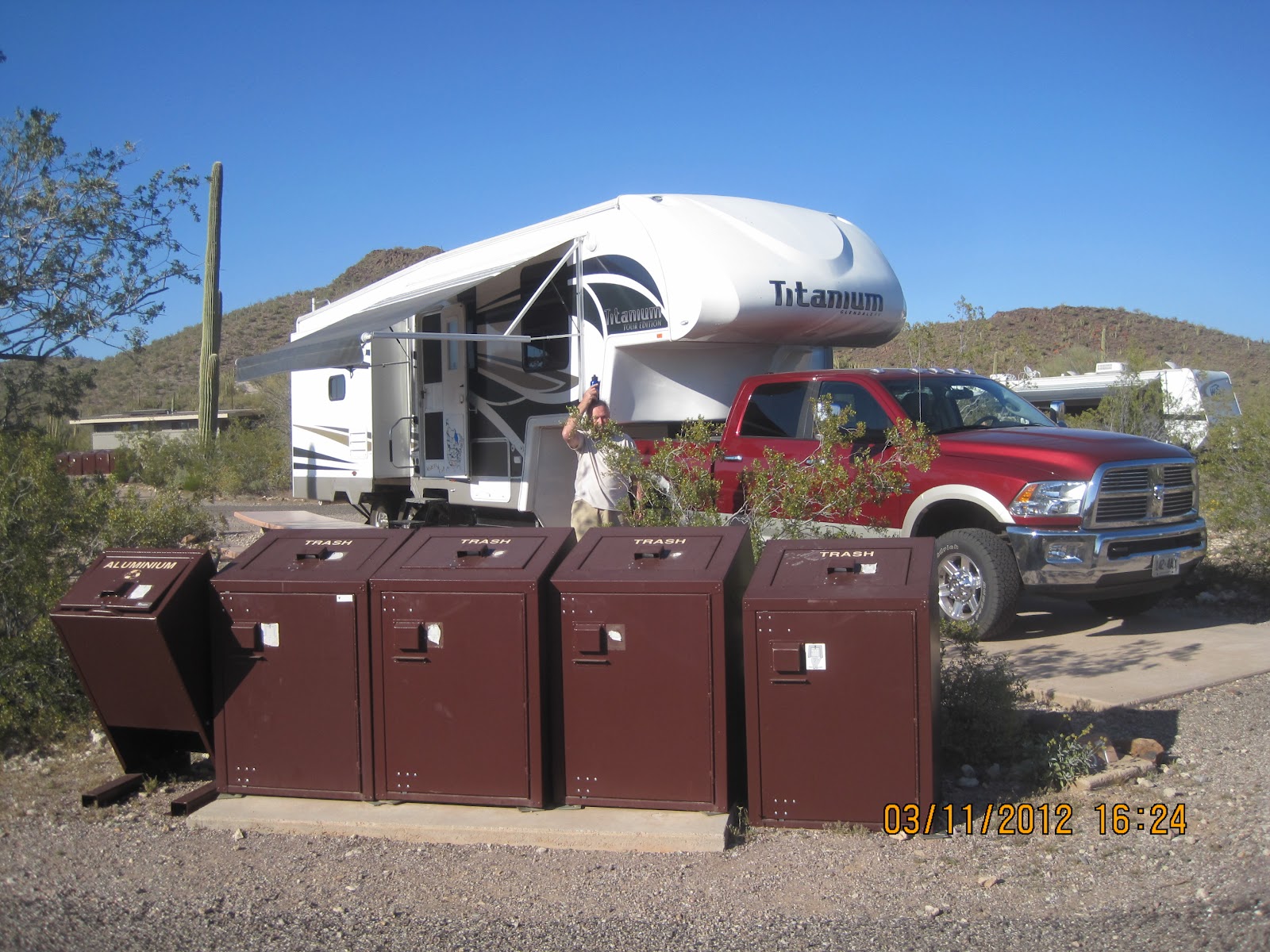
Later, we checked in to the Twin Peaks Campground, which is dry camping - no power, no water, no sewer - for 2 nights. At least we were on a concrete pad, but had the garbage bins in front of our site! The sites were large and well spaced out.
Walked around the park, which was perhaps 1/2 full. This is an Ocotillo plant blooming (at the tips). For much of the year, the plant appears to be an arrangement of large spiny dead sticks, although closer examination reveals that the stems are partly green. With rainfall the plant quickly becomes lush with small (2-4 cm) ovate leaves, which may remain for weeks or even months. It is not a cactus, but the Saguaro behind it is.
The Organ Pipe Cactus, for which the area is named:
This columnar cactus is the second largest in the U.S. (next to the Saguaro) growing as tall as 23 feet. Instead of having a central stem, however, a cluster of 5 to 20 slender branches grow from a point at ground level and curve gracefully upward.
They grow in a small area of the Sonoran Desert only from southwestern Arizona to western Sonora, Mexico, on south-facing, hot, sunny slopes from 1,000 to 3,500 feet.
In the evening, there was a Ranger Program all about Turkey Vultures, which was interesting.
The only downside to this campground is the restrictive hours that a generator can be used : 8am - 10am, and 4pm - 6pm. However, we survived!
We were on the road by 10:00, with the temperature already a sunny 21C (70F). Gonna be another hot one!
Fuelled up at Gila Bend at a Texaco - $4.299 / gallon for diesel. 1:00, the temperature has risen to 27C (80.6F).
National Parks and National Monuments: There is a (slight) Difference...
Craig Stocks, NPS
Entrance to Organ Pipe Cactus National Monument
National Parks and National Monuments are both administered by the National Park Service, and are identical in their function and purpose. Both are types of federally protected lands, and share the common goal of preserving and protecting significant natural and cultural resources.
The major difference between a national park and a national monument is the manner in which they are created. A national park is established through an Act of Congress, and the land may originate from a variety of sources, including public and private land. A national monument is established by Presidential proclamation, and this land is to be taken only from existing public (federal) ownership.Franklin D. Roosevelt created Organ Pipe Cactus N.M. on April 13, 1937.
We arrived at the Visitor Centre, watched an orientation slide show and walked an interesting nature trail.
Later, we checked in to the Twin Peaks Campground, which is dry camping - no power, no water, no sewer - for 2 nights. At least we were on a concrete pad, but had the garbage bins in front of our site! The sites were large and well spaced out.
Walked around the park, which was perhaps 1/2 full. This is an Ocotillo plant blooming (at the tips). For much of the year, the plant appears to be an arrangement of large spiny dead sticks, although closer examination reveals that the stems are partly green. With rainfall the plant quickly becomes lush with small (2-4 cm) ovate leaves, which may remain for weeks or even months. It is not a cactus, but the Saguaro behind it is.
The Organ Pipe Cactus, for which the area is named:
This columnar cactus is the second largest in the U.S. (next to the Saguaro) growing as tall as 23 feet. Instead of having a central stem, however, a cluster of 5 to 20 slender branches grow from a point at ground level and curve gracefully upward.
They grow in a small area of the Sonoran Desert only from southwestern Arizona to western Sonora, Mexico, on south-facing, hot, sunny slopes from 1,000 to 3,500 feet.
In the evening, there was a Ranger Program all about Turkey Vultures, which was interesting.
The only downside to this campground is the restrictive hours that a generator can be used : 8am - 10am, and 4pm - 6pm. However, we survived!
March 10, Yuma Lettuce Days
This morning, the park had a "Burrito Breakfast" for $2.50 per person. Fried onions, green & red peppers, ground beef, scrambled eggs & salsa on a tortilla. Fun to eat!
Then we set off for the Outdoor Swap Meet nearby. It was huge! We spent the morning wandering around there, then went into town to the "Lettuce Days" Festival at the Quartermaster State Park.
Had a delicious $2.00 salad for lunch at the Tanimura & Antle tent. It was a welcome respite from the hot sun to be under the tent.
We enjoyed the displays and free samples. Watched a Master Chef create beautiful flowers & decorations from fruits & vegetables.
Then it was back to the park to do laundry and get ready to move on tomorrow to more adventures!
March 9, Yuma Territorial Prison
Yet another sunny, warm day dawns. Off we went to tour the Yuma Territorial Prison.
The prison only operated for 33 years, from 1876 to 1909, then was closed due to overcrowding. During that time it held 3,069 prisoners including 29 women.
The main guard tower sits atop the prison's original water supply, and offers a commanding view of the area.
The main cellblock was built to house 204 prisoners. Each cell was 9' X 12' with just a bucket for a toilet, and could hold 6 prisoners. The cells were constructed of strap iron, which was brought in, and granite rock, which was quarried by the prisoners themselves. Could you imagine what today's inmates would say about those conditions?????
The "Dark Cell" was a cell excavated from granite measuring 10' X 10' and had minimal access to light. When a prisoner broke the rules, or was considered 'incorrigible', he was confined in solitary to the Dark Cell, dressed in only his underwear and existed on one meal of bread and water a day. He would sometimes have both legs individually chained to two ring bolts. The only light during the day came from a small ventilation shaft in the ceiling. After the sun went down, the prisoner was in total darkness, often sharing the cell with scorpions and rattlesnakes.
After touring the prison, we went to the "Ocean to Ocean" highway bridge, (the silver one in the foreground) which was constructed in 1915. When completed, it was the only highway bridge across the Colorado River for 1200 miles.
We walked across the single lane bridge to what we thought was California, but apparently we were still in Arizona! The bridge to the right is a railway bridge.
Friday, March 9, 2012
March 8, The Castle & Proving Grounds
Woke up to a chilly 5.8C morning, but at least the sun is shining!
Walked around the campground and had a coffee in the clubhouse. Met some strange characters! One, named Bill, who we were sure was a female! His wife was there too.
At 9:55, we set off to see "the castle" which is a private home that we were told we have to see. It was unbelievable.
We were taking photos through the fence when the owner, Josefina, came out and invited us in for a tour. The front yard is decorated with metal sculptured animals including camels, zebras, elephants, etc.
The home is incredible, from the front door throughout. The front door was huge and needed a special closer to operate it.
Josefina decorated the home, which her husband built, herself with artifacts collected from travels around the world. One room was decorated with an African theme, another was an Egyptian theme and yet another was Japanese.
Josefina sews Renaissance clothing as well as Baptism and First Communion outfits. They are very intricate and detailed.
Next it was off to the Proving Grounds where there is a museum depicting the history of the Yuma Proving Grounds from its inception in 1942 as Camp Laguna through today.
At the entrance was a display of tanks & military equipment used in various wars. Note the sign and the parent watching her child on top of the tank
Unfortunately, when we arrived at the main gate, we were told that the museum was closed, so we went to the Cactus Cafe on the base for lunch.
On the way back to the campground, we filled up with diesel at $3.93/gallon - that was the cash price, 5 cents/gallon more for a credit sale. Price keeps increasing but what do you do? Pay up!
March 7, On to Yuma
At 10:30. we were on the road, heading to Quartzsite. Planning to "boondock" - dry-camp - in the desert there for the night.
Along the way, we stopped at Parker Dam, which created the reservoir that is Lake Havasu. Although it is not classified as a wonder of the modern world, it is a spectacular engineering feat in its own right. The trouble is, you can't see what makes it so. It is 320 feet high, 235 feet of which are below the riverbed, making it the "deepest dam in the world". It is a concrete arch-gravity dam across the Colorado River that was built between 1934 and 1938. Unfortunately, due to post 9/11 security concerns, it is closed to RVs and trucks.
The weather remained windy and chilly as we continued on to Quartzsite.
At 12:50, we arrived in Quartzsite and stopped at the RV Show site for lunch. Some vendors are still there, so we wandered around the stalls. Decided to continue on to Yuma, since it was cold & windy and we would prefer to have hookups!
On the way heading south to Yuma, we saw lots of RV's dry camping in the desert! However, that was not for us today.
We entered the Yuma Proving Grounds, which is an immense area where equipment and ammunition are tested.
A few miles further on, we found we were passing fields of crops! In the desert! Most people think of Arizona as a big, dusty desert, they are surprised to learn that agriculture is Yuma County's number one industry - and that Yuma is North America's winter vegetable capital. That's because several things come together here. Plentiful sunshine, rich soil and good water. With mild winters and more than 350 days of sunshine a year, Yuma County enjoys the longest growing season in the country!
Growing more than 175 different crops every year, Yuma agriculture is a $3.2 Billion industry.
At 4:50, we arrived at Southern Mesa RV Park, south of Mesa. It has Wi-Fi!
Winds have subsided and temperatures are supposed to return to normal tomorrow.
Subscribe to:
Posts (Atom)